Every "Moving to Lincoln Park" guide tells you the zoo is free and Pequod's has a caramelized crust. True. Neither fact helps you sign a lease.
This is the version I'd give a client sitting in my passenger seat between showings: what a unit here actually rents for, what hits your bank account on day one, what changes legally in January, and the timing window that separates the renters who get a deal from the ones who get outbid.
1. The "average rent" you googled is wrong — all four versions of it
Search Lincoln Park rent and you'll get numbers between roughly $1,700 and $2,650. They're all technically accurate. They measure different pools.
Source (2026) | Lincoln Park figure | What it's actually measuring |
|---|---|---|
RentCafe (July) | $2,351 average, up 5.13% year over year | Large managed apartment communities |
Zumper (April) | $2,650 median, up ~3% year over year | Listings across property types |
RentHop (July) | $2,600 median, roughly $49/sq ft | Active + rented listings that month |
$2,567 average | Advertised listing inventory |
Which is why the neighborhood average is the wrong number to budget against. Here's what those same sources look like broken out by bedroom count:
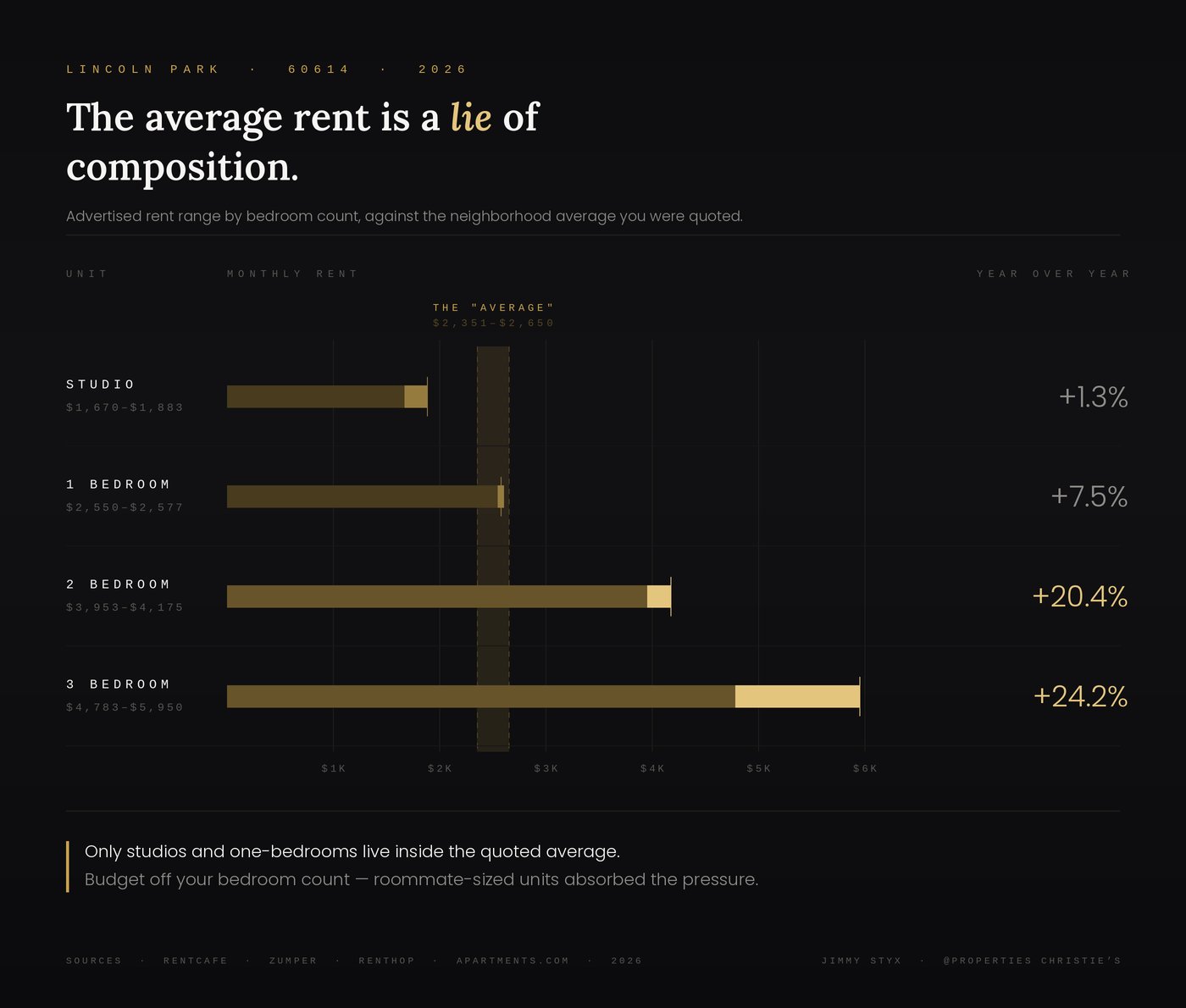
Roommate-sized units absorbed the pressure. Two-bedrooms rose more than 20% year over year and three-bedrooms more than 24%, while studios stayed nearly flat.
The takeaway: Budget off the bedroom count figure, not the neighborhood average. The neighborhood average is dragged down by studios and dragged up by Sheffield.
2. Lincoln Park isn't one rental market. It's seven.
The 60614 zip covers a set of distinct sub-neighborhoods, and the price gap between them is larger than the gap between most Chicago neighborhoods:
- Sheffield Neighbors — DePaul's backyard. Most energy, most competition, and the highest rents in the area (RentCafe has pegged Sheffield near $3,793). Student lease cycle drives availability.
- Ranch Triangle (Racine, Armitage, North, Chicago River, Halsted) — the dining and shopping core. Armitage retail, rowhouses, converted vintage.
- Wrightwood Neighbors — quietest and most residential. Vintage walk-ups, families, park access, no nightlife foot traffic.
- Park West — tree-lined, closest to the lakefront and the zoo, older courtyard buildings.
- Old Town Triangle — historic, tightly held, low turnover.
- DePaul / West DePaul — most rental-dense, best value per square foot, most roommate inventory.
- Clybourn Corridor — newer construction, big-box convenience, easiest parking.
Pick the pocket before you pick the listing. A $2,600 one-bedroom in Wrightwood and a $2,600 one-bedroom in Sheffield are two different lifestyles.
3. Your move-in cost is not first month's rent
Chicago runs differently than most of the country, and the difference costs newcomers real money.
Security deposit vs. move-in fee. Chicago's Residential Landlord and Tenant Ordinance (RLTO) makes security deposits legally expensive to hold: the deposit must sit in a separate, interest-bearing Illinois account, interest must be paid annually (the city's published rate has been 0.01% since 2017), an itemized statement of deductions is due within 30 days of move-out, and the deposit itself within 45. Violations can cost a landlord double the deposit plus attorney's fees.
The result: most Chicago landlords skip deposits entirely and charge a non-refundable move-in fee instead. It's usually smaller than a deposit — and you never see it again.
Budget for the full stack:
- First month's rent
- Move-in fee (non-refundable) or security deposit (refundable, up to 1.5 months under RLTO)
- Application / credit screening fee per adult
- Building elevator or freight reservation fee (common in high-rises)
- Pet fee and monthly pet rent
- Utility setup — ComEd and Peoples Gas, plus internet
- Renters insurance, often required in the lease
- Chicago city sticker if you're bringing a car (required within 30 days of moving to the city), plus a residential parking zone add-on of roughly $30/year in permit-zone blocks
Rule of thumb: Assume 1.5× to 2× your monthly rent in cash on day one. On a $2,600 one-bedroom, that's $3,900 to $5,200 before the first moving truck shows up.
Note: RLTO coverage carves out owner-occupied buildings of six units or fewer. Small-building rentals often play by different rules.
4. The fee rules change January 1, 2027 — and your lease may be signed before then
Illinois passed the Rental Fee Transparency and Limitations Act (HB 3564), signed in June 2026. It was originally set for July 1, 2026; a companion bill (HB 5234) pushed the effective date to January 1, 2027.
What it does, once it's live:
- Every non-optional fee must appear on page one of the lease. If it isn't disclosed there, the tenant isn't liable for it.
- Application and background check fees capped at $50 (with limited exceptions).
- Bans fees for lease modification or renewal.
- Bans fees for after-hours maintenance requests.
- Bans pest abatement fees where the tenant didn't cause the infestation.
- Requires utility inclusion to be disclosed in the lease or the listing.
- Landlords can't rename a fee to dodge the law, and tenants get a private right of action. Owner-occupied buildings of six units or fewer are exempt.
Separately, the City of Chicago is weighing the Protecting Renters Ordinance (PRO), introduced to City Council committee in June 2026, which would cap security deposits at one month's rent and effectively prohibit move-in fees. It has not passed.
What this means for you right now: A lease signed in fall 2026 is governed by today's rules. Read the fee schedule line by line, get every charge in writing before you apply, and ask whether the renewal fee structure changes in January.
This is general information, not legal advice. For a specific lease dispute, talk to a tenants' rights attorney.
5. The 2026 market has bidding wars. Yes, on rentals.
This isn't marketing hype. In April 2026, Fox 32 and Axios both reported North Side renters — Lincoln Park and Lakeview specifically — being asked to submit best-and-final offers above the listed rent, with winning bids landing thousands over ask.
The math behind it: Chicago vacancy is running just under 5%, occupancy is projected to hold near 95% through 2026, and new apartment deliveries are forecast around 4,400 units — roughly half the ten-year average. Fewer new units, steady demand, tight inventory.
Show up to a tour ready to sign the same day:
- Photo ID
- Two most recent pay stubs, or an offer letter with start date and salary
- Two years of tax returns if you're self-employed
- Bank statements
- Prior landlord contact and rental history
- Guarantor's documents, if you need one
- Funds available to apply immediately
The renter with the complete file wins the unit. Consistently.
6. Timing is the biggest lever you control
Chicago's rental calendar is rigid. Current tenants typically decide on renewal 30 to 60 days out, so units hit the market roughly four to eight weeks before they're available. Search earlier than that and you're looking at inventory that won't exist by your move date.
- Start your search 60 days before move-in. 90 days if you're targeting summer.
- May through August is peak. Most inventory, most competition, highest pricing. Lincoln Park spikes hardest here because DePaul's cycle and the post-graduation wave land at the same time.
- October through February is the discount window. Fewer options, but landlords facing a winter vacancy negotiate. Concessions, shorter terms, and free months live here.
If you're reading this in late summer: You're at the back end of peak season. Inventory is thinning but pricing pressure is easing. September and October move-ins are the smartest value play of the year.
7. The car question
Lincoln Park sits about two miles north of downtown, served by the Brown, Red, and Purple Express lines, with a Transit Score of 79 and a walk score that puts most daily errands inside a few blocks.
Run the honest number: a deeded parking space adds meaningfully to monthly rent, and street parking in the permit zones means a city sticker plus a zone add-on, plus guest permits, plus meters running around $5 for two hours on Halsted. For a lot of renters, the CTA plus occasional rideshare beats the all-in cost of the space. For others — anyone commuting to the suburbs — parking is non-negotiable and should be a filter, not an afterthought.
8. In Chicago, a rental broker costs you nothing
This one surprises people relocating from New York or Boston.
In Chicago, the landlord or management company pays the broker's commission. The renter pays nothing. Fair housing rules mean the advertised rent is the same whether you tour alone or with an agent — you don't get a worse deal for having representation.
What you get instead: someone who knows which buildings are quietly offering a free month, which management companies actually respond to maintenance tickets, which blocks flood, and which listings are bait that's already leased. Someone who reads the fee schedule before you sign it.
If a "locator" asks you for an upfront fee to access their listings, walk.
Ready to look?
Send me your budget, move-in date, and must-haves. I'll come back with a curated list of Lincoln Park units that actually match — including off-portal inventory and current concessions — and I'll tour them with you. No cost to you, ever.
Not moving for a few months? Get on my Lincoln Park availability list. I'll send you what hits the market 60 days before your date, before it goes public.
Zenlist — my search, on your phone. Free.
Zenlist is invitation-only — no public signup, no ads, no other agent getting your info. You see Lincoln Park listings the same minute I do, straight off the MLS. Scan the code, and we build your search together: pocket, budget, bedroom count. New matches push to your phone; you save what you like, and we're touring by the weekend.

Jimmy Styx is a licensed Illinois real estate broker with @properties Christie's International Real Estate.
Sources
- RentCafe — Lincoln Park average rent and market trends: https://www.rentcafe.com/average-rent-market-trends/us/il/cook-county/chicago/lincoln-park/
- Zumper — Lincoln Park rent research: https://www.zumper.com/rent-research/chicago-il/lincoln-park
- RentHop — Lincoln Park average rent: https://www.renthop.com/average-rent-in/lincoln-park-chicago-il
- Apartments.com — Lincoln Park apartments: https://www.apartments.com/lincoln-park-chicago-il/
- Axios Chicago — Chicago renters face bidding wars (April 2026): https://www.axios.com/local/chicago/2026/04/15/chicago-rent-bidding-wars-housing-shortage-demand-2026
- MMG Real Estate Advisors — 2026 Chicago forecast: https://mmgrea.com/2026-chicago-forecast/
- Illinois General Assembly — HB 3564 bill status: https://www.ilga.gov/legislation/BillStatus?DocNum=3564&GAID=18&DocTypeID=HB&LegId=162254&SessionID=114
- Chicago Association of REALTORS® — Protecting Renters Ordinance summary: https://chicagorealtor.com/advocacy/advocacy-resources/protecting-renters-ordinance-pro-issue-summary/
- Chicago Office of the City Clerk — Residential zone parking: https://www.chicityclerk.com/about-residential-zone-parking-permits